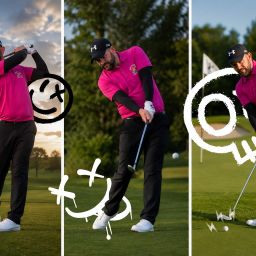

Well… here we are.
Four weeks until the season starts.
To be honest, I’m not entirely sure where the winter went. One minute I was scraping ice off the windscreen to get to the range, the next I’m looking at competition dates and wondering if my golf swing remembers who I am.
This season feels different.
I’ve joined a new club, met some brilliant people over the winter months, and I’ve got a whole new golf course to learn. New challenges, new opportunities and, if history is anything to go by, a few new ways to make a complete mess of a scorecard.
I’m excited.
I’m nervous.
Mostly excited.
The thing I’m looking forward to most is finally getting out and playing Largs Golf Club properly. The course has a fantastic reputation and there’s a reason people refer to it as “Ayrshire’s Augusta”. The greenkeepers take enormous pride in the place and everyone I’ve spoken to says the course is always in incredible condition.

I can’t wait to see it for myself.
With the season fast approaching, I started asking myself the usual questions.
What should I work on?
How often should I practice?
What’s going to make the biggest difference?
And perhaps most importantly…
How do I avoid trying to fix seventeen things at once and ending up worse than when I started? After some thought, I decided to keep things simple.
Everything falls into three categories:
Physical. Technical. Mental.
If I can improve those three areas consistently, I should become a better golfer. At least that’s the theory. The reality, as every golfer knows, is that golf has a habit of laughing at your theories.
Control everything that’s controllable
Building The March Plan
I know I can realistically dedicate around 10 hours per week to improving my golf.
Everyone’s time will be different, but the principle remains the same. Work out what you’ve got available and spend it wisely.
The first thing I need to do is learn my new course. One practice round every week takes roughly four hours.
That leaves six hours.
Split equally between Physical, Technical and Mental training gives me two hours per category each week. Simple. Even I can do the math on that!
Physical Training
30 minutes – 4 days per week
Total: 2 hours
Monday, Wednesday, Friday and one weekend session.
This is where I work through the stretching and mobility programme put together by Paul Moultrie.
Strength.
Mobility.
Flexibility.
Balance.
Basically all the things that stop me moving like a rusty garden gate halfway through the back nine. The older I get, the more I realise golf fitness isn’t about turning into Rory McIlroy. It’s about being able to bend down and pick your tee up without making noises that sound like you’re opening an old wooden treasure chest.
Technical Training
2 x 1-hour range sessions
Session One – Monday Night
This session focuses on improving a weakness.
At the moment that’s my long game.
Driver.
Fairway woods.
Hybrids.
5 Iron.
The big sticks. The clubs that can make you feel like a tour professional one shot and a complete beginner the next.
Session Two – Wednesday Night
This session is all about increasing my skill set. Building shots I can call upon when I need them. One of my favourite drills is the famous 9 Box Drill.
Low Fade
Mid Fade
High Fade
Low Straight
Mid Straight
High Straight
Low Draw
Mid Draw
High Draw
Can I hit all of them consistently? Absolutely not. Can I occasionally produce one by accident? Yes. Often.
The second drill is creating a Wedge Matrix.
I carry four wedges.
For each wedge I practise:
Pocket to Pocket
Hip to Hip
Shoulder to Shoulder
Full Swing
Four wedges.
Four swing lengths.
Sixteen stock shots. That’s sixteen different yardages I can hopefully rely on when the pressure is on. Or at least sixteen different ways to leave myself a ten-foot putt.
Mental Training
4 x 30-minute sessions
This is the area I think most amateur golfers neglect. We obsess over swing changes. We buy new clubs. We watch YouTube videos at midnight. But very few golfers actively train their mind.
My four sessions are:
1. Visualisation
This is one of the most powerful things I’ve ever worked on.
I picture standing on the tee.
I feel the breeze.
I hear the birds.
I see the fairway.
The sky is blue.
The clouds are drifting by.
I picture a red shot tracer leaving the clubface.
Every detail matters.
Then I walk through my pre-shot routine exactly as I would on the course.
The goal isn’t simply imagining success.
It’s making success feel familiar before it happens.
2. Reading
I love reading.
Books allow you to dive deeply into a subject in a way social media never can.
Some books I’ve read multiple times because the lessons were so valuable.
If you’re not a reader, try this.
Set a timer for 30 minutes.
No distractions.
No phone.
No scrolling.
Just read.
You’d be amazed how much you learn.
Every time I’ve recommended golf books to friends, the response is usually:
“I’m not much of a reader.”
Fair enough.
They’re usually the same people who can somehow watch four straight hours of YouTube golf videos.
Funny how that works.
3. Podcasts
There are some brilliant golf podcasts out there.
The standout for me is Chasing Scratch.
In many ways it’s one of the inspirations behind this blog.
Mike and Eli are two golfers trying to reach scratch.
They’re funny, relatable and completely obsessed with improvement.
Sound familiar?
There are currently nine seasons and I’d strongly recommend starting from Episode 1 and enjoying the journey.
No spoilers.
Just trust me.
Some incredible things happen.
I also enjoy The Golf IQ Podcast. Short episodes. Great advice. Lots of practical ideas you can apply immediately.
4. Planning
This is where I prepare for competition golf.
I check:
Weather forecast
Temperature
Wind speed
Wind direction
Recent course conditions
From there I build a game plan. And once the plan is written down, I commit to it. No standing on the first tee suddenly deciding I’m apparently Bryson DeChambeau.
The plan covers everything:
Wake up time
Breakfast
Hydration
On-course nutrition
Warm-up routine
Likely club choices
Clothing
I try to arrive an hour before my tee time. Check in with Andy in the Pro Shop. Hit some irons in the nets. Roll a few putts. Stretch. Relax. Then go play golf. Simple. Well… Simple in theory.
Any dream written down becomes a goal, a goal broken down becomes a plan
Everything I’ve described here has come from working with Paul Moultrie at Mind Body Golf. At the time of writing my handicap index sits at 13.4.
I’m happy with that. But I’m not planning on staying there.
If I stick to this process, keep myself accountable and trust the work, I fully expect that number to come down.
So that’s March.
No magic secrets. No miracle cures. Just a plan. Now comes the hard part. Actually doing it.
I’ll report back at the start of April and let you know whether I’ve become a golfing machine…
…or whether I’m still trying to hit that perfect fade that only seems to exist during practice swings.
See you on the first tee.